|
|
|
Glossary of Industry Terms
|
Section A: General Definitions
fluid - Any gas or liquid.
gland - A cavity into which a seal is installed, including the groove and mating surface which confine the seal.
seal - Any device that prevents the passage of a fluid.
Section B: Seals and Related Components
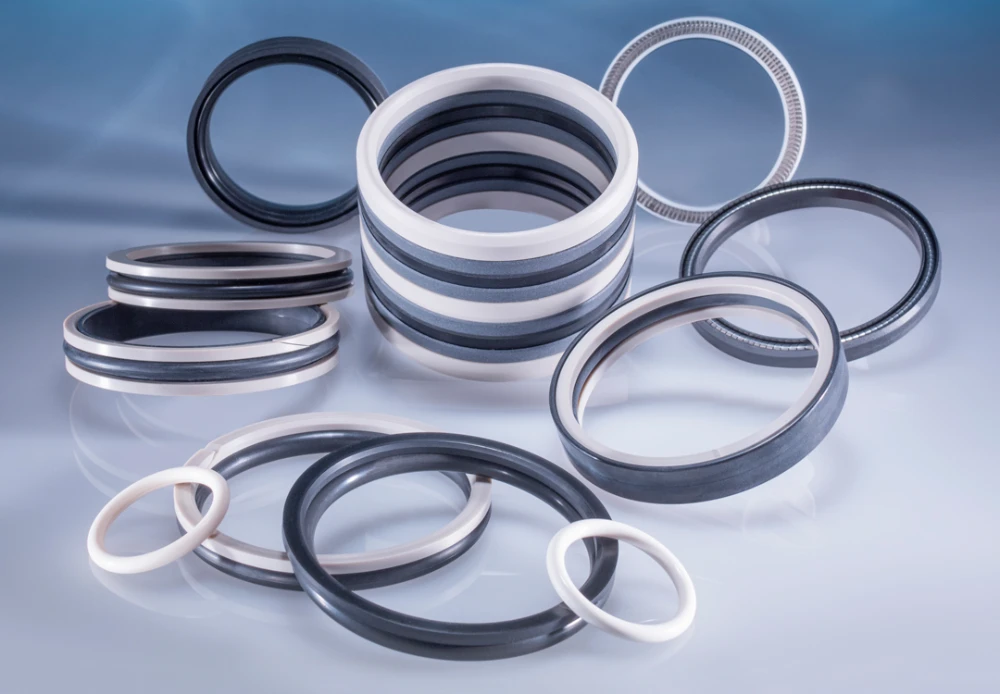
anti-extrusion ring - Ring installed on the low pressure side of a seal to prevent extrusion into the clearance between the supporting metal parts.
backup ring - See anti-extrusion ring.
composite seal - Seal composed of two or more materials of differing flexibility or hardness, usually bonded together.
double-acting seal - Seal to prevent the passage of fluid from either direction relative to its axis.
dynamic seal - Seal designed to prevent leakage between adjacent surfaces which move relative to each other.
face seal - Device which seals by means of axial contact pressure, usually between two surfaces in a plane at right angles to the axis.
gasket - Static seal made from deformable material and compressed between plane surfaces.
lip seal - Seal having one or more axially extending flexible members which form the sealing surfaces.
O-ring seal - Ring of toroidal form, usually of elastomeric material.
O-ring seal, trapped - A type of seal using an O-ring with a special groove form. Typically a dovetail shape.
rectangular section - Ring of rectangular cross-section, usually of elastomeric seal material.
scraper - A device to keep out dirt or other foreign matter.
single-acting seal - A seal which prevents the passage of fluid from one direction only, relative to its axis.
static seal - A seal in which there is no relative motion between the adjacent surfaces being sealed.
toroidal seal - See O-ring seal.
U-ring seal - Seal of substantially "U" section having either flat or round base fitted with axially extending "lips" toward the pressure to be sealed.
wiper ring - A device to keep out dirt or other foreign matter.
Section C: Common Sealing Terms
axial interference - Difference in dimension between the axial width of a seal and the axial space into which it is installed.
break-away friction - Frictional force required to start a body in motion over a surface.
break-out friction - See break-away friction.
coefficient of friction - The force in the direction of motion required to move one surface with respect to another divided by the force normal to the two surfaces.
diametral clearance/interference - Difference between the I.D. (inside diameter) of the seal and the shaft diameter, or between the O.D. (outside diameter) of the seal and the housing diameter.
extrusion - Displacement of part of a seal into the extrusion gap under the action of fluid pressure or thermal expansion.
extrusion gap - The clearance on the low-pressure side between components which confine the seal.
heel - The part of a U-ring adjacent to the extrusion gap on the nonpressure side.
interference load - Pressure loading which arises at the surface to be sealed, caused by deformation of the seal material during assembly.
inter-seal pressure - Fluid pressure which may in some circumstances arise between two seals fitted to a double-acting piston.
kinetic friction - Minimum frictional force required to maintain a body in motion sliding over a surface.
lip - That part of a U-ring seal which forms the sealing surface.
radial clearance/interference - Difference in dimension between the radial section of a seal and the radial space into which it is installed.
running friction - See kinetic friction.
squeeze - The deformation of a seal caused by the difference in dimension between the seal and the space into which it is installed.
static friction - See break-away friction.
stick-slip - The jerky motion of one surface when it is dragged across another surface.
stiction - The increase in static friction which occurs with time of stationary contact of a seal.
Section D: Elastomeric Materials
aging - Changes in rubber occurring with the passage of time. Qualification of this term is usually necessary, e.g., heat aging, light aging.
aging test, accelerated - Test in which an attempt is made to produce and measure effects of natural aging in a shorter time.
air trap - Unintentional void in a rubber molding.
antioxidant - Compounding ingredient used to retard deterioration caused by oxidation.
antiozonant - Compounding ingredient used to retard deterioration caused by ozone.
atmospheric or ozone cracking - Cracks produced in the tensioned surface of rubber by exposure to the ozone of the atmosphere.
back-rinding - Defect in which the rubber adjacent to the flash line shrinks below the level of the molding.
blister - Bubble of air or gas indicated by a protrusion on the surface of a molded rubber part.
bloom - Material which has diffused to the surface of rubber to give a cloudy or milky discoloration. It does not usually impair usefulness.
brittle point - Temperature at which a material breaks under defined conditions of deformation.
butt joint - Joint made with the two ends cut at right angles to the length of material.
chamfer - A beveled or sloping edge (typically 45 degrees) to reduce the sharp intersection of two faces.
chalking - Formation of a powdery surface condition due to disintegration of surface binder or elastomer, caused by weathering or other destructive environments.
composition - Kinds and proportions of ingredients for or in a mix.
compound - Mixture of rubber with compounding ingredients; sometimes referred to as a mix.
compounding ingredients - Material or substance added to a rubber to form a mix.
compression molding - Molding process in which the blank is placed directly in the mold cavity and compressed to shape by closure of the mold.
compression set - The residual deformation of a material after removal of a compressive stress.
copolymer - A polymer in which the molecules are of two or more different kinds.
creep - A time dependent deformation of a material under load.
curatives - Chemicals such as sulfur which, generally with the application of heat, bring about cross-linkage of polymer molecules, usually termed Vulcanization or curing.
cure - Vulcanization; conditions necessary to produce a given state of vulcanization.
cure date - Date when rubber parts were molded.
curing agent - See curatives.
Durometer Gauge - An instrument for measuring the hardness of rubber. Measures resistance of the rubber surface to deformation by an indentor point.
durometer - A numerical scale of rubber hardness.
elasticity - The tendency of a body to return to its original size and shape after being deformed.
elastomer - Macromolecular material which can return rapidly to the approximate shape from which it has been substantially distorted by a weak stress. Elastic, rubber-like material.
elongation - Increase in length caused by a tensile force and expressed numerically as a fraction or percentage of the initial length.
elongation, ultimate - Increase (expressed as a percentage) in original length of a specimen when it reaches its breaking point. See elongation.
flash - Excess material protruding from the surface of a molded part, appearing on a mold parting line or mold vent points.
flash line - A raised ridge or "witness" produced on a molding by flow of material into the junction between separate parts of the mold.
flex cracking - Surface cracking induced by repeated bending or flexing.
flow crack - Surface imperfection due to improper flow and failure of the material to knit or blend with itself during the molding operation.
flow mark - Mark or line on a molding, caused by imperfect fusion of flowing fronts.
fluoroelastomer - A polymeric material which is partially fluorinated (some hydrogen positions replaced by fluorine) and which exhibits good chemical resistance.
formulation - Kinds and proportions of ingredients for a mix, together with the method by which they are to be incorporated.
gas trap - See air trap.
hardness - A material's ability to resist a distorting force. Measured by the relative resistance of the material to an indentor point. See durometer.
hysteresis - The energy lost in a complete cycle of deformation and retraction.
injection molding - Molding process in which mix is forced into a closed heated mold from a separate chamber.
low-temperature effects - Changes induced by low temperature are primarily physical and are reversible. When warmed, an elastomer will regain its original properties.
migration - Transfer of ingredient from an elastomeric compound to a material with which it is in contact.
migration stain - Stain caused by migration.
mismatch - A defect produced from a mold whose parts are not in register. Generally a break or step in a supposedly continuous surface.
mix - See compound.
modulus - Tensile stress measured at a particular strain and expressed in psi. Normally defined at 50% or 100% strain.
mold mark - Surface imperfection transferred to a molding from a corresponding mark in a mold.
molding shrinkage - Decreased dimensions of a rubber molding, compared with mold cavity, arising from difference in coefficient of thermal expansion of the rubber material and the mold material and the chemical change produced by curing.
nibbling - The removal of tiny bits of elastomeric material caused by the seal material repeatedly extruding through a small opening (extrusion gap or gap between a back-up ring and the metal surface) under pressure fluctuations, vibration or other relative movement. The rubber material can also be "pinched off" due to side loads increasing and decreasing the extrusion gaps.
offset - See mismatch.
parting line - See flash line.
perfluoroelastomer - A fully fluorinated (all hydrogen positions replaced by fluorine) polymeric material exhibiting high resistance to chemical attack.
permanent set - Permanent distortion of an elastomer after deformation.
plasticizer - Petroleum derivative or ester-type material added to a mix which increases the processibility, gives control over the hardness and plasticity, and strongly influences the low-temperature characteristics.
pockmark - Shallow depression on the surface of a molding.
polymer (elastomeric) - Result of a chemical linking of molecules into a long chain-like structure. Natural and synthetic rubbers and rubber-like materials are polymers.
reinforcing agent - Compounding ingredient used to increase one or more of the three properties: abrasion resistance, tear resistance and tensile strength.
resilience - Ratio of energy returned to energy input when rubber is made to undergo a single cycle of rapid deformation.
Rockwell Hardness - Units of hardness measure by the resistance of a material (typically metal) to indentation by a spherical tipped conical diamond indentor (Rockwell C and A) or, in the case of softer materials, a hardened steel sphere indentor (Rockwell B).
rubber - Macromolecular material which has, or can be given, properties of:
(a) returning rapidly (at room temperature) to the approximate shape from which it has been substantially distorted by a weak stress, and (b) not being easily remolded to a permanent shape by the application of heat and moderate pressure. NOTE: The term "rubber" is also applied to articles made from rubber.
rubber, natural - Rubber formed by a living plant.
rubber, synthetic - Rubber other than natural rubber.
scarf joint - Joint made by cutting the ends of a length of material at an angle to correspond to each other and overlapping them.
scorch - Premature curing of an unvulcanized rubber as a result of subjecting it to an excessive amount of heat during processing.
Shore A Hardness - A unit of hardness measured by the resistance of a material to indentation by a steel pin under spring force typically used for soft rubber. The lower the number the softer the material. Max value is 100.
Shore D Hardness - A unit of hardness measured by the resistance of a material to indentation by a steel pin under spring force typically used for hard rubber and plastics. The lower the number the softer the material. Max value is 100.
spew - Excess material forced from a mold on closure under pressure.
stress relaxation - Decrease in stress occurring with lapse of time in a body in constant strain or deformation.
tear resistance - The ability of a material to resist the enlargement of a nick or cut, when tension is applied to the damaged specimen. Normally, this is expressed as "pounds per inch thickness".
tensile strength - Maximum tensile stress applied uniformly over the cross-section of the test piece in the course of stretching the test piece to rupture. By convention, calculated on the original cross-section.
tension set - Ratio of the residual lengthening of a test piece, after stretching and release, to the initial length after a given lapse of time.
thermoplasticity - Ability to exhibit plastic flow with rise of temperature and to revert to comparative rigidity on cooling and to repeat the cycle indefinitely.
TR-10 - A test for approximating the low-temperature capabilities of an elastomer compression seal.
transfer molding - Molding process in which a quantity of mix is forced into a closed heated cavity or cavities from a heated chamber integral with the mold.
volume change - The change in a seal's volume resulting from immersion in a fluid. This is usually expressed in terms of a percentage of the original seal volume.
volume shrinkage - Decreased physical size caused by the extracting action of a fluid or by heat, expressed as a percent volume change.
volume swell - Increased physical size caused by the absorption of a fluid, expressed as a percent volume change.
Vulcanizate - Product of Vulcanization.
Vulcanization - Process of changing the chemical structure of rubber, converting it so that the elastomeric state exists over a greater range of temperature; in some cases the process is extended so that the substance becomes rigid. - Any device that prevents the passage of a fluid.
|
|