


Greene Tweed Innovation Award Winner Spotlight:
Engineering Record-Breaking Speed for Hydrogen Compression

When a semiconductor customer came searching for seals free from per- and polyfluoroalkyl substances (PFAS) for their highly critical application, the talented team of scientists, engineers, and technicians at Greene Tweed (GT) sprang into action. They developed customized, next-generation, PFAS-free elastomers that meet the customer's extreme cleanliness and performance demands, with potential to surpass the incumbent FKM in the application. Originally engineered for semiconductor manufacturing, these PFAS-free sealing solutions hold promise for many industries facing similar sustainability and performance objectives Hydrogen compression pushes materials to their limits. Its low molecular weight requires centrifugal compressors to operate at extreme speeds, beyond what conventional metallic impellers can withstand. To overcome this challenge, a Greene Tweed team in Switzerland developed a composite closed impeller capable of achieving a record-breaking tip speed of 688 m/s, nearly doubling the limits of conventional metallic impellers that typically operate at speeds of up to 360 m/s for closed designs and 500 m/s for open designs before burst.
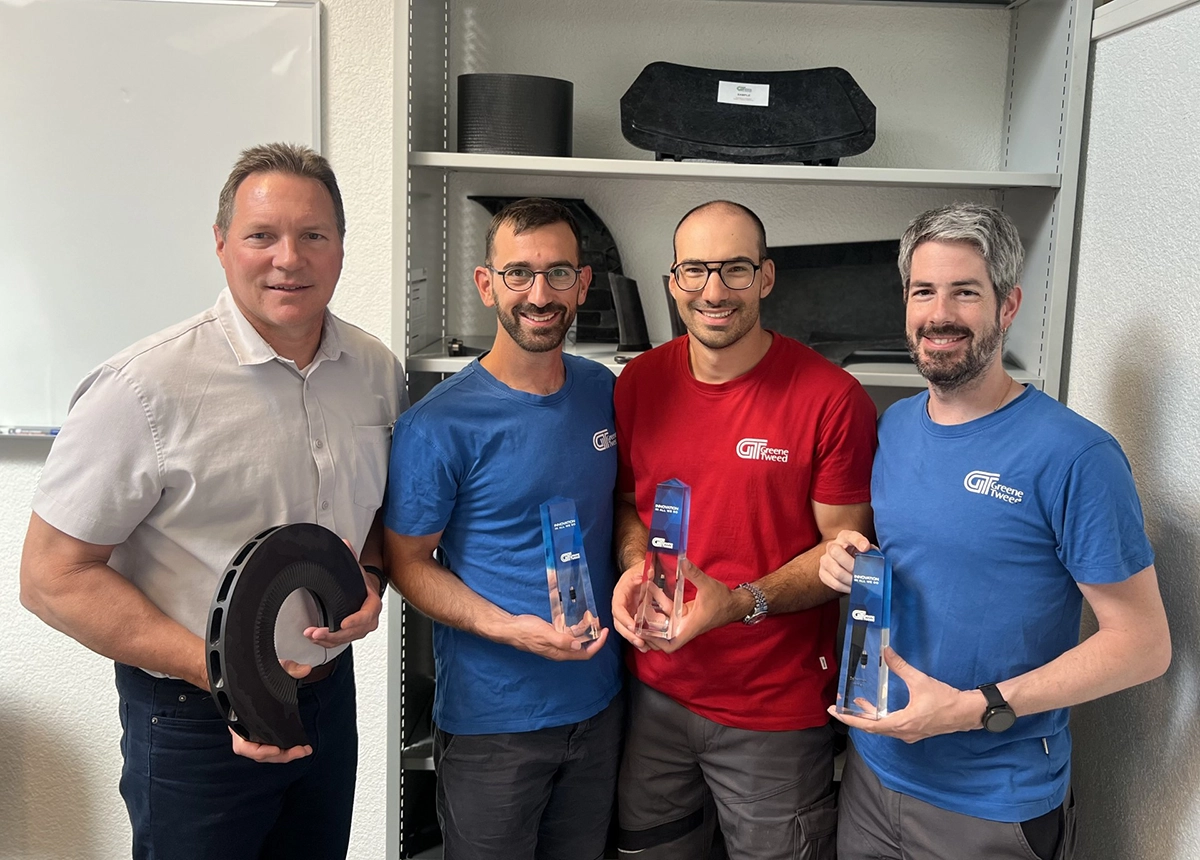
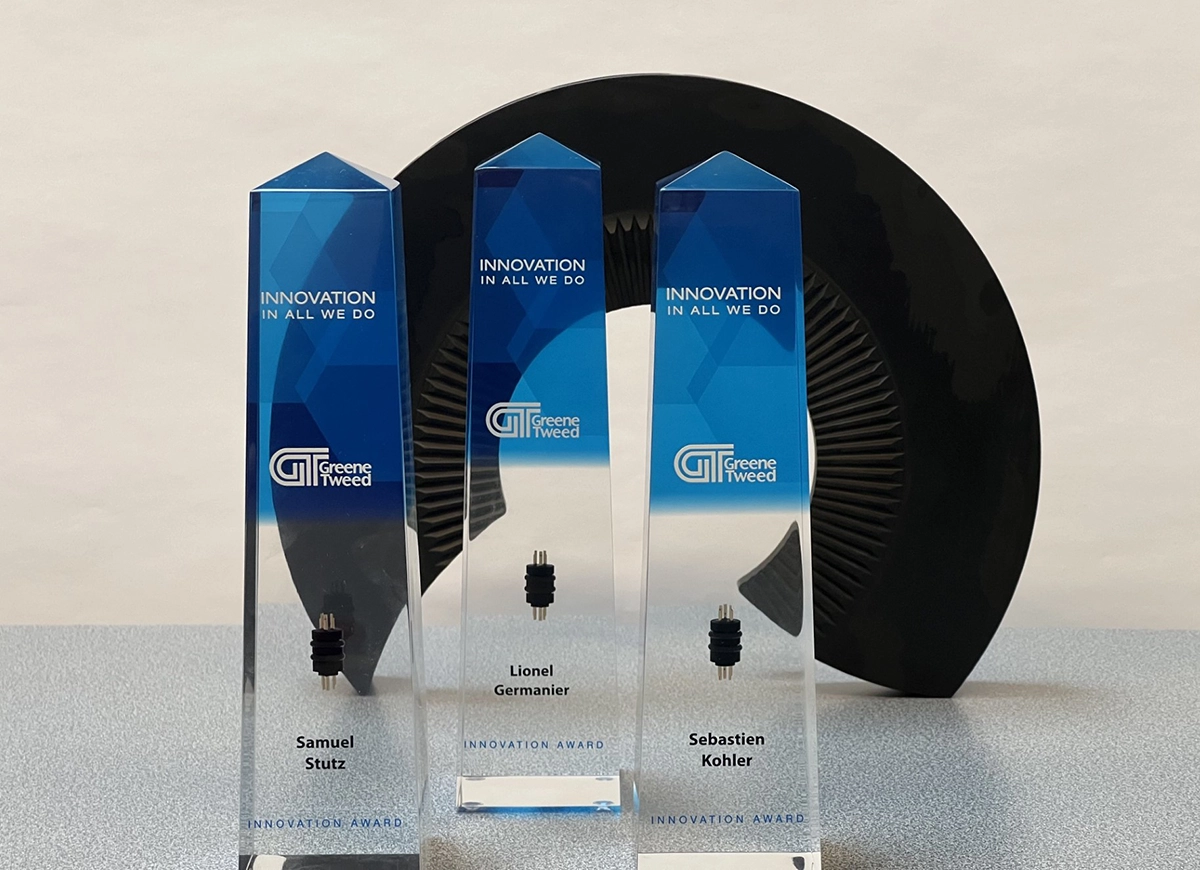
In recognition of this achievement, Greene Tweed (GT) awarded our prestigious Innovation Award, which spotlights and rewards exceptional efforts to push the boundaries of innovation and collaboration, to the three-member team behind the development: Samuel Stutz, Technology Manager; Sébastien Kohler, Senior Scientist; and Lionel Germanier, Engineer II.
Soon after the special event, where Structural and Engineered Components General Manager George Rawa presented the award to them at our site in Yverdon-les-Bains, Switzerland, we sat down with the winning team to learn about the composite compeller and its impact on scaling large-scale clean energy infrastructure.
1. Let’s start with what you’re being recognized for. Can you tell us more about the PEEK composite impeller and its impact on the clean energy industry?
Samuel Stutz: Worldwide, there is a lot of push to decarbonize industrial processes and transportation to limit the increase of CO2 levels in the atmosphere. Companies that make, for example, glass, tiles, bricks, concrete or steel, all depend on a hot burning flame which currently is natural gas. Hydrogen gas seems to be a potential replacement for these continuous processes. This is why many regions are planning huge investments in hydrogen pipelines. It turns out that this brings many significant technical challenges.
The one challenge we solved with this innovation is the continuous compression of hydrogen in a centrifugal compressor. Indeed, hydrogen, being the lightest molecule, requires incredibly high rotational speeds (actual tip speed) for the impeller to work efficiently. While current metallic impellers can rotate with tip speeds around the speed of sound in air, hydrogen needs speeds that are beyond 2x that value. Centrifugal forces will rip apart metal impellers long before reaching these values. It is only with the exceptional strength and light weight of composite materials that these extreme conditions can be reached.
Sébastien Kohler: While the idea of taking advantage of the higher strength to weight ratio of composites in an impeller application is not new, actually making a part that lives up to the expectation is much more complex due to the complicated processing involved. Our team’s deep thermoplastic composite processing knowledge and resourcefulness allowed us to unlock the potential of these materials in such a highly complex geometry application.
2. Can you share the journey behind the impeller that led to this award?
Lionel Germanier: It was not a short or straightforward project. We had to make several iterations, do coupon testing, and go through several iterations of process improvements. I’ve been working on this project since I joined Greene Tweed in 2020, so it is really rewarding to get this recognition for all the effort the Swiss team put into exceeding our 600m/s tip speed target.
We started with a different design approach, but the results were not as good as expected. We had to work on the fiber placement and figure out the right architecture that would perform under the high stress that the impeller sees during the test.
The assembly of the part in the testing machine is also very important. With high speed, everything will expand, so you need to keep the impeller in the center of rotation otherwise it will be unbalanced and can cause additional stress on the part and vibration. We spent a lot of time brainstorming and simulating what influence different architectures will have in this complex load case.
3. How would you describe its impact?
Sébastien: This innovation is an enabling step to unlock a future hydrogen economy, no matter whether the hydrogen is consumed directly or as a way to store and / or transport energy from other sources. One way or another, very large volumes of hydrogen gas will be created and moved to support renewable energy.
Such large gas throughputs require the use of centrifugal compressors to be economically viable, and these centrifugal compressors need faster spinning impellers to be able to compress pure hydrogen gas. Without this impeller, hydrogen would need to be mixed with heavier gases to enable compression, and the gasses then separated again before use, which would add a lot of cost and complication.
Furthermore, centrifugal compressors are also currently limited by impeller material limitations in certain other existing applications such as methane, supercritical carbon dioxide, or ammonia compression. A composite impeller could help in those instances too, by increasing the compression ratio of each stage, enabling the design of smaller, cheaper machines with less stages.
4. How do you envision the trajectory of this impeller?
Sébastien: We still have a lot of work to do to better predict the material behavior of our composites in such an application. Traditional numerical models have always relied on strength and damage prediction for well-controlled load cases where the loads lie in the plane of the parts. In this instance, we have significant out-of-plane loadings and multi-directional loads to contend with, which calls for novel model development and a lot of experimental testing to support this effort with useful, high-quality data.
This development will support faster customer support for impeller projects, cutting down the time required for Finite Element Anaysis (FEA) to one-tenth and improving performance predictability. It is as challenging as it is exciting, and I’m very happy that we were able to partner with a Swiss university and receive significant Swiss state funding for this research.
5. What were the most significant lessons or insights you gained from this experience?
Lionel: Be curious and try things, even if in theory it seems impossible or has never been done. You will always learn something that could be applicable for another project. Of course, this experience has contributed to my growth. When I joined Greene Tweed I had very little experience in composite materials. Growing up with this project was really rewarding.
6. Do you want to acknowledge the role of any additional collaborators or leaders who played a role in supporting or nurturing the innovation process?
Samuel: This innovation is the result of an exceptional team that works daily with innovation and optimization in mind. I also want to thank Nenad Srejic (Production Supervisor) and Mico Kovcic (Technician) for the molding, and Guillaume Aeby (Senior Technician) and Jeremy Frutig (Apprentice) for the machining of these parts. This project is big and long-lasting. The support and trust of the company over the years is clearly what enabled this, and is a wonderful testimony of a living culture of innovation.
Sébastien: This was really a team effort, and the vertical integration and agility of this unit in Greene Tweed’s Advanced Technology Group dedicated to support the Structural and Engineered Components (SEC) business unit were key to achieving this great result. One should also not minimize the courage needed from the SEC business unit and its leadership, who recognized this development as a “big bet” and funded it internally as a Technology Development (TD) project for over five years, allowing us to achieve results that ensured commercial involvement from customers.
7. Any advice for aspiring innovators?
Samuel: If you have an idea that sounds difficult to realize, and you are unsure whether the return at the end justifies the hard work, don’t give up, think bigger. Ask yourself, what will it take to change your idea from a good idea to an exceptional idea everybody will want? Use the power of the team, share and discuss your thoughts to come up with good ideas, and then make them great!