


Greene Tweed Innovation Award Winner Spotlight:
Rapid Prototyping Gets Advanced Air Mobility to Fly Faster

How do you keep up with the fast innovation cycles in Advanced Air Mobility (AAM) without compromising quality? That was the question facing Greene Tweed when it started expanding its lightweight, high-performance thermoplastic composite Xycomp® DLF™ beyond traditional aerospace.
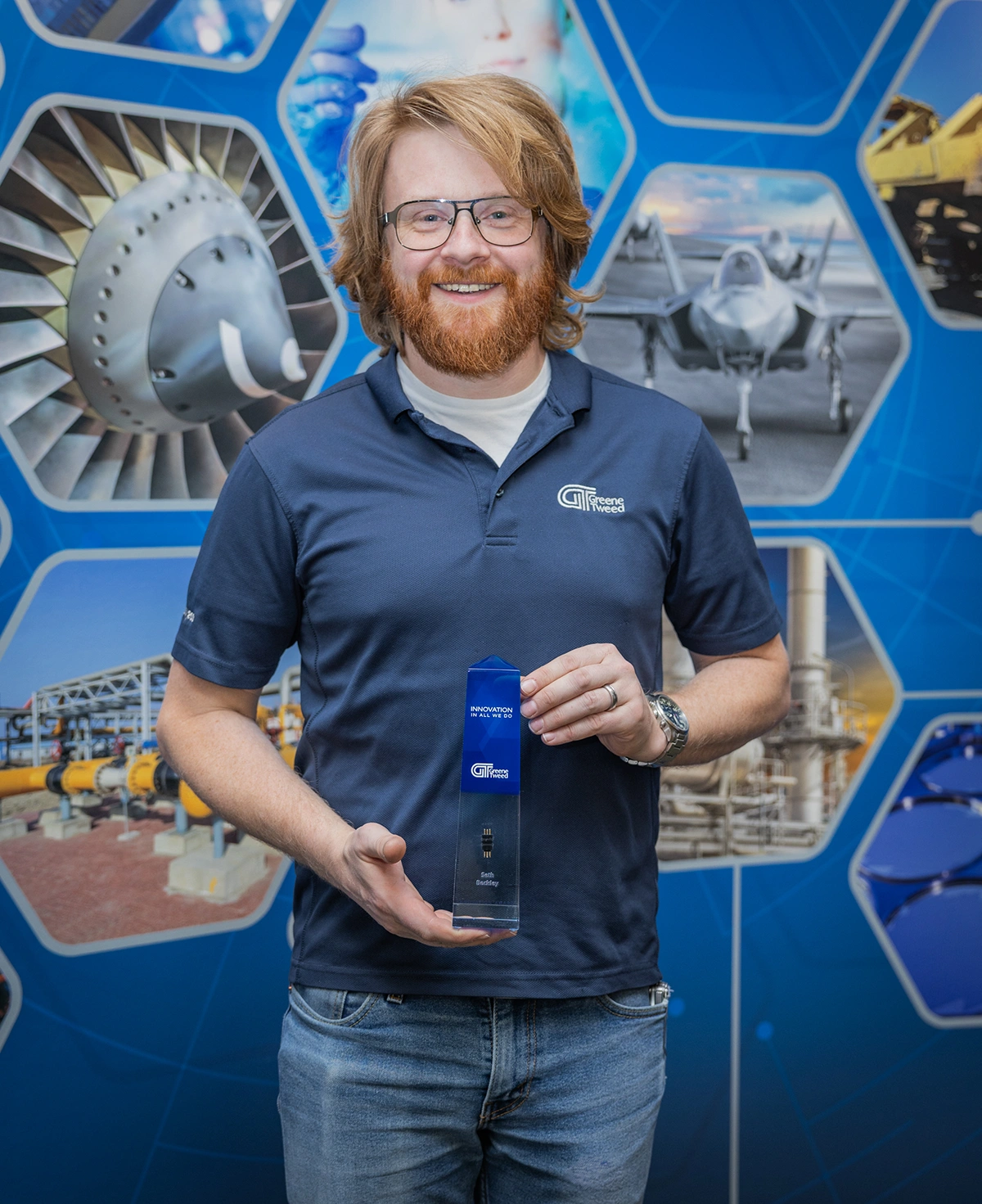
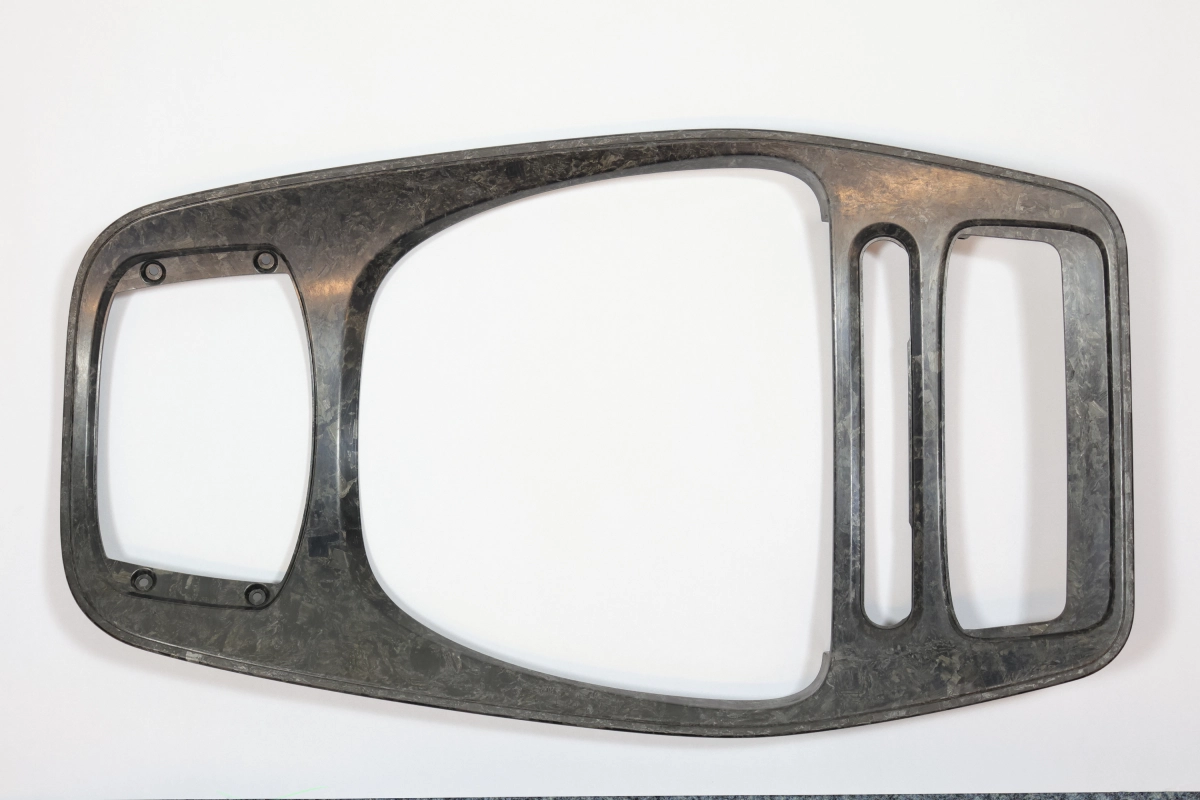
In response, Senior Development Engineer Seth Beckley pioneered a groundbreaking rapid prototype tooling strategy. His new approach cuts the industry-standard 16-to-20-week production timeline for Xycomp® DLF™ parts by 50% by simplifying mold design and optimizing the balance between machined and net-molded features, while maintaining the quality of production-grade components.
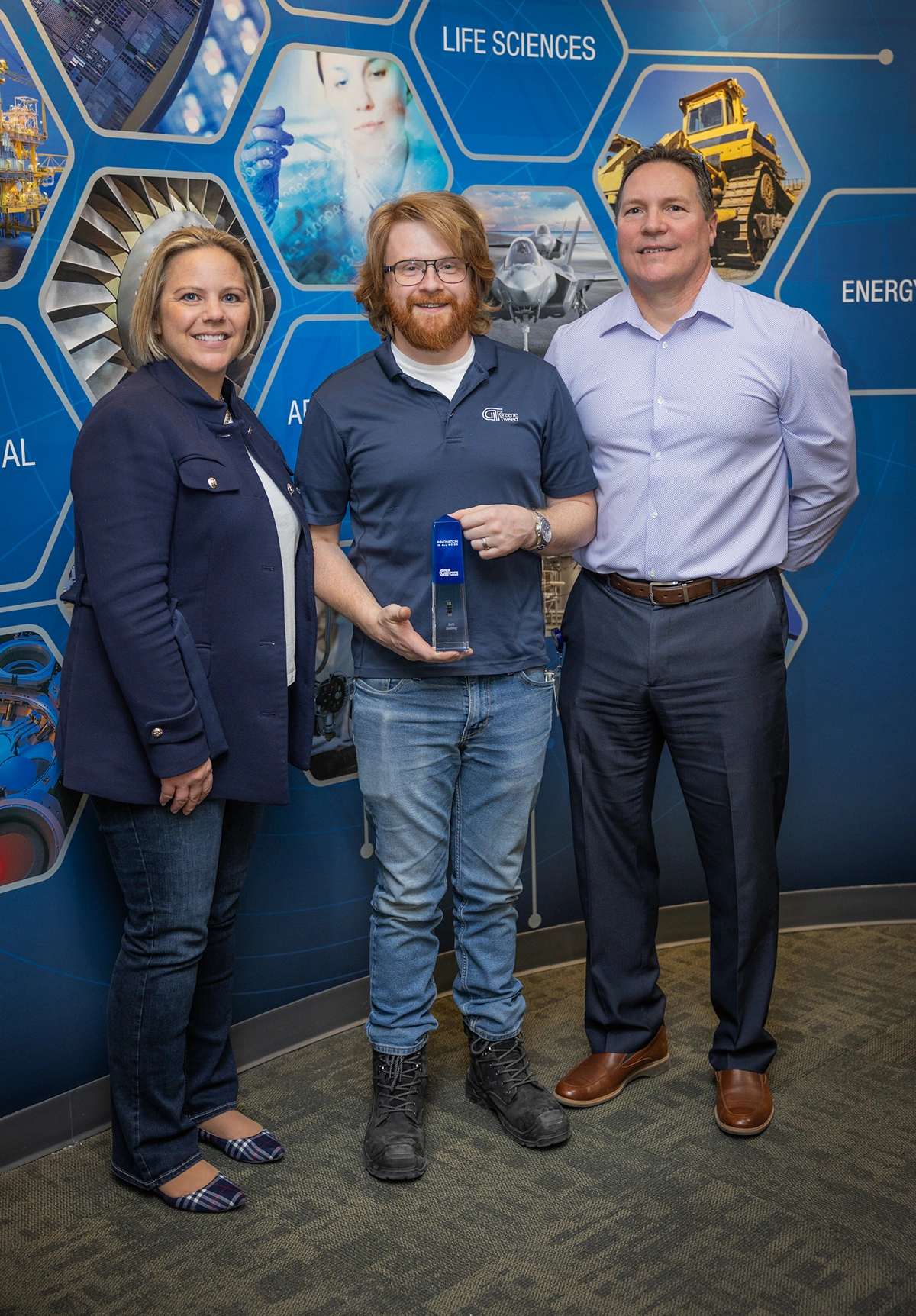
To celebrate this significant breakthrough, Greene Tweed awarded Seth its prestigious Innovation Award, which spotlights and rewards exceptional efforts to push the boundaries of innovation and collaboration. Soon after the award ceremony, where CEO Magen Buterbaugh and Structural and Engineered Components General Manager George Rawa presented the award to him, we sat down with Seth to learn about the rapid prototyping process that is accelerating advancement in the AAM and defense industry.
Let’s start with what you’re being recognized for.
For Xycomp® DLF™ parts historically, the typical timeline from finalizing a part design to delivering the first pieces is 16-20 weeks. A large portion of that time is spent building production-quality mold tools and machining fixtures intended to last for decades. There are numerous good reasons for this approach, and it aligns with many customers’ expectations and project schedules.
As we expanded Xycomp® DLF™ into new industries, such as mobile robotics, advanced air mobility, defense, and high-performance automotive, it became apparent that our typical lead times and tool costs were going to be a barrier to success. These industries need functional parts in-hand as quickly and cheaply as possible, with the expectation of real-world testing and design modifications before moving into production.
To meet this demand, we developed a molding and tool design strategy that drastically reduces the complexity of tooling, enabling significant cost and lead-time improvements.
What does this award mean to you personally and professionally?
I’ve been a fan of the innovation award since its introduction. We’re a company with a long history of impressive innovations. This award is a great way to encourage and recognize new innovations.
Xycomp® DLF™ is a product line that’s been marked by innovation from its inception, and I’ve been privileged to be part of that development for most of my career at GT. The rapid prototyping process is another step in advancing our Xycomp® DLF™ capabilities. It’s been deeply rewarding to help establish this process and see its strong reception and success with our customers.
Can you share the story/journey behind the innovation or project that led to this award?
The inspiration for the rapid prototyping process goes back to 2020-2021, during the slowdown in the commercial aerospace industry caused by Covid-19. As we started to look outside our primary market, we found two recurring themes: Our tooling costs and part lead times were high, and many customers just needed to get functional parts into testing, without the extensive qualifications that we typically deliver.
To address those concerns, we piloted a modular tool concept with inexpensive, swappable cavity inserts. We ended up producing over 400 parts from that prototype tool, validating the approach and collecting valuable data. Next, we developed a set of more complex, standalone mold tools for a defense customer. That project really broke ground for the rapid prototyping approach, with a record 7.5-week lead time for delivered parts using inexpensive, rapidly built tools. We also used that project to explore a new approach to machining using rapidly built fixtures that let us align machining development time with the expedited molding development schedule.
How would you describe the impact of your innovation?
The rapid prototyping process has been a game changer for Defense and AAM customers. As a result of this process, GT has multiple critical components on a new defense vehicle expected to move into production soon. Our ability to meet tight project timelines has opened up doors to explore parts with several other engineering groups at the same customer.
In the AAM market, we’ve delivered prototype parts to several customers to enable test vehicle fit ups. We see again and again that these types of customers like to iterate; they don’t necessarily know what the final product is going to look like until they’ve physically built a vehicle and tested it. Enabling them to get parts in hand quickly and without commitment to production-rate tooling has made us a trusted partner.
This enables them to iterate faster, accelerate their development cycles, and bring innovative aircraft to market faster. As a result, we see new parts coming our way.
How do you envision the trajectory of this new process?
There are numerous ways we can push this innovation further. We’re still exploring how complex the parts can become using this approach, along with ways to improve surface treatments, enhance material performance, improve tool life, and reduce costs further. We’re also working with our partner tool shops to develop a hybrid path to tooling, one that would get us the fit and finish we expect on production tools, but with designs and materials that would lower the cost and lead time closer to prototypes.
Do you want to acknowledge the role of any collaborators or leaders who played a role in supporting or nurturing the innovation process?
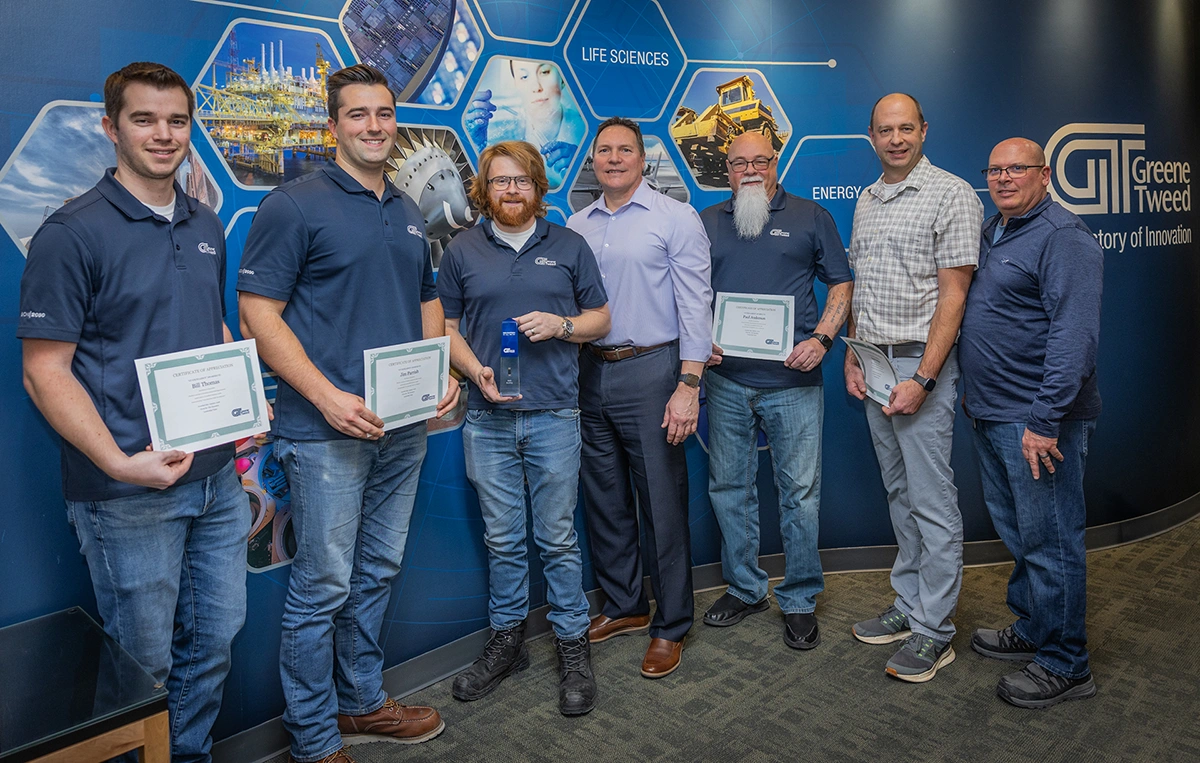
A project like this is truly a team effort. Steve Kerbaugh, senior mechanical designer, is an expert in Xycomp® tool designs. His expertise and feedback on the early tool designs were invaluable. Paul Anderson, senior CNC programmer, deserves huge credit for his expertise in machining. He offered invaluable advice on machining fixture approach cleverly repurposed an obsolete fixture into a universal machining fixture base and did all of the CNC programming for the parts we’ve run through the prototype approach, quickly and efficiently.
When it came to executing the prototype approach, the whole SEC Development Engineer team was involved. Senior Development Engineers Bill Thomas, Jim Parrish, Chris Schwall, and Senior Development Technician Lester Mushinski, all played critical roles, from hand-fitting the tools to developing molding recipes and performing final part assembly, all to meet the customer’s expedited schedule. Finally, Brad Keller, SEC DE Manager, freed my time to focus on this effort. He prioritized CNC programming and machine time, and pulled the team together as needed, ensuring the success of the project.
Any advice for aspiring innovators at Greene Tweed?
I’ve done my best to learn as much as possible about many different things. I brought together experience with part design, mold design, molding process development, and machining to develop the rapid prototyping approach. Greene Tweed has always been an environment where trying new things is encouraged, and I’ve certainly been given many opportunities to experiment. Trying new things comes with risks! It doesn’t always go well, and sometimes innovation fails. It’s important to know when to push ahead through a setback and when to pivot.
You May Also Like:
PFAS-free Seals with Potential to Surpass Incumbent FKM in Cleanliness
Semi-automated Packaging Line — Where Humans and Robots Collaborate