



All Your PFAS Questions, Answered

The conversation around PFAS (per- and polyfluoroalkyl)-free materials often generates more questions than answers. In our latest live webinar, Greene Tweed experts Dr. Bret Neese and Ralph Chiaravolloti reveal how they are using non-fluorinated surfactant (NFS) polymers to develop PFAS-free products that outperform and outlast the competition in harsh industrial settings. Discover the Greene Tweed approach to supplier collaboration, product diversification, and portfolio innovation.
You can view the full webinar here, but first, here’s your sneak peek at the toughest PFAS questions our customers are asking:
1. What is PFAS, and why is it critical for high-performance applications in harsh environments?
The strength of the carbon-fluorine bond, one of the strongest in organic chemistry, gives PFAS materials their unparalleled durability and stability. For example, fluoropolymers such as Greene Tweed’s Chemraz® and Fusion® are widely used in sealing solutions and structural components where failure is not an option, due to their ability to withstand extreme temperatures and aggressive chemicals.
While replacing fluoropolymers in critical applications is challenging, Greene Tweed is leveraging its expertise in material science to innovate and develop PFAS-free solutions.
2. Are all PFAS materials the same?
No. PFAS is a broad class of chemicals with diverse properties and applications. Fluoropolymers, such as those used to make Greene Tweed’s Chemraz® and Fusion®, are considered polymers of low concern. Their large molecular weight and stable, long-chain structure prevent bioabsorption and bioaccumulation, posing minimal risk to human health and the environment.
3. What is Greene Tweed’s approach to developing PFAS-free materials?
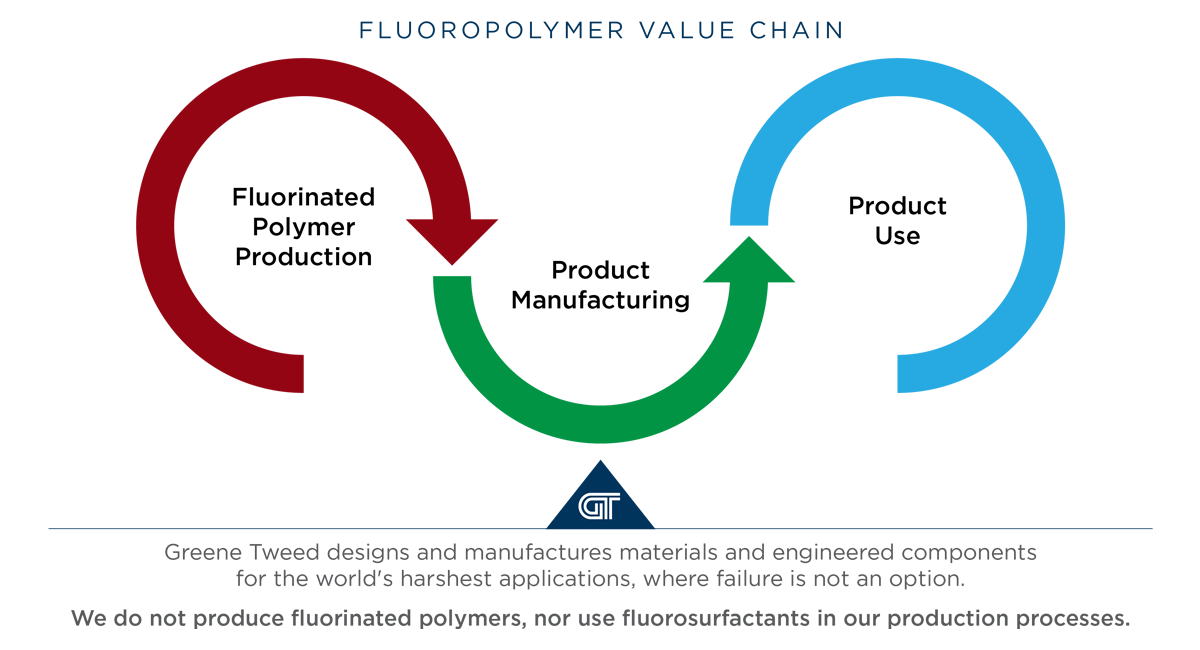
Greene Tweed is executing a proactive, multi-faceted strategy to engineer the next generation of materials. First and foremost, Greene Tweed does not polymerize fluoropolymers or use fluorosurfactants in our manufacturing processes. We’re working with our suppliers to move to non-fluorinated surfactants (NFS) and leveraging advanced formulation science to engineer specialized compounds.
THIS APPROACH INCLUDES:
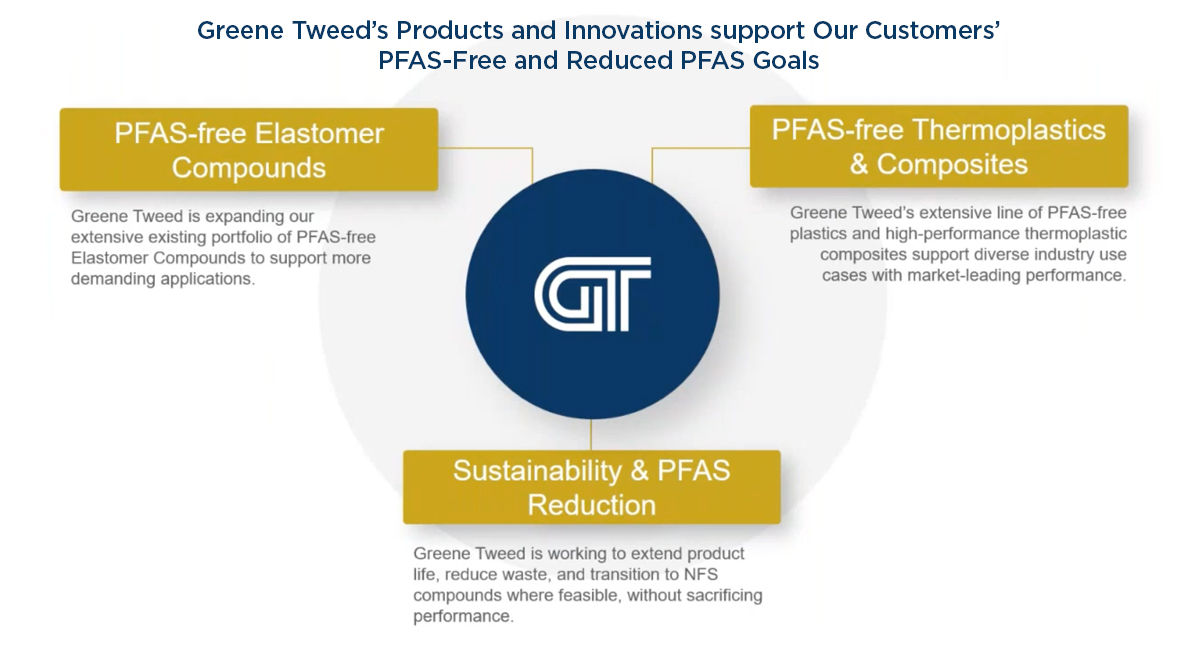
- Developing PFAS-free elastomers and thermoplastics: Greene Tweed is leveraging its expertise in formulation science to create advanced PFAS-free materials. For example, they are developing elastomers for applications up to 180°C (356°F) and thermoplastic composites for temperatures up to 301°C (575°F) with enhanced tribological and chemical resistance properties.
- Securing a robust NFS supply chain: Greene Tweed collaborates with fluoropolymer producers to test and refine non-fluorinated surfactant (NFS) materials. The Fusion® F07 is an example of a Greene Tweed product that features an NFS polymer base while maintaining performance.
- Collaborating with customers: Greene Tweed works closely with customers to identify and qualify specific applications where PFAS-free materials can be effectively implemented. This ensures materials are optimized for real-world performance.
4. Does utilizing PFAS-free materials mean sacrificing performance?
No. Many assume that utilizing materials that are not traditional fluoropolymers requires a step down in capabilities, but Greene Tweed is demonstrating that this transition can be done without sacrificing performance.
The company is leveraging advanced formulation science and engineering expertise to develop PFAS-free elastomers and thermoplastics that meet or even exceed performance benchmarks in select applications.
For example, Greene Tweed has shown promising results in developing NFS materials for semiconductor applications, with compounds that exhibit excellent compression set, plasma resistance, and retention of physical properties at high temperatures. Similarly, PFAS-free thermoplastic composites, such as cross-linked PEEK, have demonstrated superior tribological performance and chemical resistance compared to traditional PFAS-based materials.
5. Does Greene Tweed foresee a shortage of FFKM or other PFAS-based polymers?
No, Greene Tweed does not anticipate an immediate shortage of FFKM or other PFAS-based polymers. As a global company with multiple manufacturing sites and one of the largest purchasers of FFKM on the open market, Greene Tweed maintains a diverse and resilient supply chain.
Our strategic foresight includes both securing current material supply and aggressively advancing our portfolio of PFAS-free solutions to mitigate any future risks and ensure an uninterrupted flow of innovative, high-performance products to our customers.
Challenge Us
We invite semiconductor, aerospace, energy, chemical processing, and life sciences industry leaders to challenge us with their most demanding requirements. Together, we can engineer the next generation of high-performance, PFAS-free solutions that set new benchmarks for performance, reliability, and sustainability.
You May Also Like:
PFAS-free Seals with Potential to Surpass Incumbent FKM in Cleanliness