


PEEK vs PEK vs PTFE
WHAT IS PEEK MATERIAL?
 PEEK (polyetheretherketone) is a semi-crystalline thermoplastic with outstanding chemical resistance and mechanical strength across a broad temperature range, low moisture uptake, solid fire performance, and good dimensional stability. PEEK material properties make it a standout choice for applications requiring durability and performance in extreme conditions. These PEEK material properties also enable designers to consolidate multiple components into a single part, reducing weight and improving overall system efficiency without compromising strength or reliability.
PEEK plastic properties make it strong and rigid with superior creep resistance, and delivers where thermal, chemical, and combustion properties are critical. PEEK polymer retains its properties in harsh high-pressure and high-temperature (HPHT) environments. Arlon 3000XT®, Greene Tweed’s proprietary cross-linked PEEK resin, has proven creep and extrusion resistance at temperatures above 350˚F (177˚C). The unique PEEK plastic properties, such as its high strength-to-weight ratio and resistance to aggressive chemicals, make it a versatile material for demanding applications.
PEEK material is widely recognized for its combination of strength, thermal stability, and chemical resistance, making it ideal for high-performance applications in aerospace, automotive, oil and gas, and medical industries. As an advanced engineering thermoplastic, PEEK material offers long-term reliability in extreme environments, including high temperatures and aggressive chemicals. Whether used in seals, electrical connectors, or structural components, PEEK polymer material delivers high performance and durability where other plastics fail. PEEK material's properties make PEEK material a preferred choice for engineers seeking lightweight, high-strength alternatives to metals. For applications requiring flat, rigid components, PEEK sheet material is often utilized for its excellent dimensional stability and ease of machining.
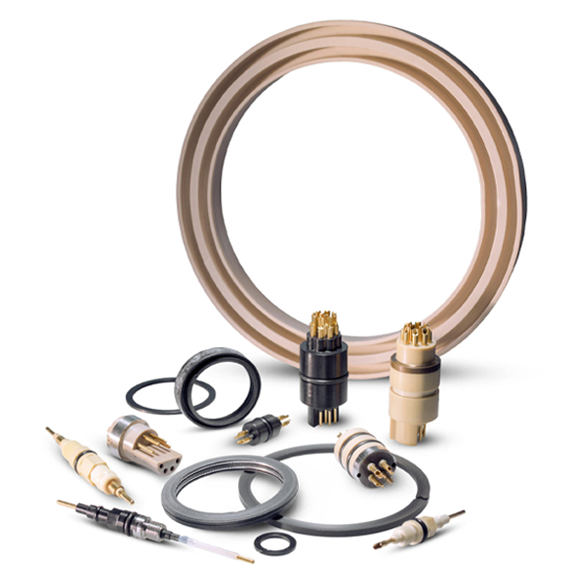
Greene Tweed’s proprietary PEEK resin has proven its superior resistance. As constant innovators, Greene Tweed was the first company to use PEEK material in several oilfield applications. PEEK plastic is often used as the body for electrical connectors to take advantage of PEEK plastic properties, such as thermal expansion, provide chemical resistance, and to promote effective sealing. Greene Tweed also uses PEEK materials for a variety of sealing system components, sensor housings, aircraft engines, and other demanding environments. The use of PEEK sheet material in these applications allows for precise fabrication of components with consistent performance under harsh conditions.
PEEK Manufacturing Process
The production of high-performance components from PEEK begins with PEEK resin: small pellets that represent the pure form of this exceptional material. These PEEK resin pellets are fed into specialized high-temperature extruders or compression molding presses, where they are melted at temperatures exceeding 343 °C (649°F) and formed into semi-finished stock shapes such as thick PEEK sheet material, round rods, tubes, thin films, or continuous filament. Throughout this step, the fundamental chemistry of the PEEK polymer remains unchanged, ensuring that the resulting PEEK sheet material and other stock shapes retain the full set of outstanding PEEK plastic properties, including extreme heat resistance, chemical inertness, and mechanical strength. Once cooled and crystallized, these semi-finished forms are precision-machined for specific applications.
PEEK Plastic Properties
Here are the standout PEEK plastic properties that make it a top choice for replacing metals in extreme environments:
- Continuous Use Temperature: Up to 260°C (500°F) – operates reliably in extreme heat where most plastics fail
- Melting Point: ~343°C (649°F) – outstanding thermal stability for repeated sterilization
- Mechanical Strength: 90–110 MPa (unfilled), up to 250+ MPa (reinforced) – retains high strength even at elevated temperatures
- Stiffness (Flexural Modulus): 3.6–4.0 GPa (unfilled), up to 25 GPa (carbon/glass filled) – excellent resistance to bending and deformation
- Coefficient of Thermal Expansion (CTE): ≈45–55 × 10⁻⁶ /°C – very low and close to aluminum, ensuring dimensional stability
- Chemical Resistance: Inert to nearly all solvents, acids, and hydrocarbons (only attacked by concentrated sulfuric acid)
- Wear & Abrasion Resistance: Extremely high, especially in carbon-fiber or bearing-grade versions – ideal for sliding and wear parts
- Flame Retardance: UL 94 V-0 rating with very low smoke and toxic gas emission – meets strict aerospace and transportation standards
- Hydrolysis & Steam Resistance: Excellent even at 250–280°C – perfect for repeated autoclave/steam sterilization
- Dielectric Strength: 18–22 kV/mm – superior electrical insulation at high temperatures and frequencies
- Radiation Resistance: Very high resistance to gamma and e-beam radiation – used in nuclear and medical sterilization
- Biocompatibility: FDA-compliant and USP Class VI grades available – widely used for implants and surgical instruments
- Creep Resistance: Excellent – maintains shape under long-term loading
These properties together make PEEK one of the highest-performing thermoplastics available
WHAT IS PEK?
PEK (polyetherketone) is a ketone-based, semi-crystalline thermoplastic. PEK delivers high thermal dimensional stability, low flammability, outstanding chemical resistance, and excellent mechanical properties over a wide temperature range.
Because PEK retains its strength as temperatures rise, it is ideal for applications with vibrational or cyclic loading conditions and where components must withstand high mechanical loads at high temperatures for extended periods of time, such as gears, shafts, bushes, bearings, and miniature rotational precision parts in the aerospace and automotive industries.
PEK retains its properties at temperatures up to 30˚C higher than traditional PEEK materials. Combined with good creep and fatigue resistance, PEK provides a property set uncommon in most polymers.
Like PEEK polymer, PEK is also often used as the body for electrical connectors to minimize thermal expansion and provide effective sealing and chemical resistance.
PEK Properties
PEK is a close relative of PEEK, but with an even higher continuous service temperature and glass transition temperature.
Key PEK plastic / PEK polymer properties include:
- Continuous use temperature: Up to 280 °C (often rated 20–25 °C higher than standard PEEK)
- Glass transition temperature (Tg): ~165–170 °C (vs ~143 °C for PEEK)
- Melting point: ~370–375 °C (higher than PEEK’s 343 °C)
- Mechanical strength & stiffness: Slightly higher than unfilled PEEK at elevated temperatures
- Chemical resistance: Essentially identical to PEEK — outstanding against almost all chemicals
- Thermal stability: Superior long-term performance above 250 °C
- Wear resistance & creep: Comparable or marginally better than PEEK
In short, engineers choose PEK when the application regularly sees temperatures between 250 °C and 280 °C, where PEEK begins to lose some stiffness.
PEK Manufacturing Process
The PEK manufacturing process is similar to that of PEEK. PEK resin originates as small pellets, which are dried thoroughly and then processed on specialized high-temperature injection molding machines, extruders, or compression presses capable of barrel temperatures up to 400–420 °C. The molten PEK polymer is shaped into semi-finished stock forms such as thick PEK sheet material, rods, tubes, and films. After controlled cooling and annealing to maximize crystallinity, these stock shapes are machined for specific applications.
WHAT IS PTFE?
PTFE (polytetrafluoroethylene) belongs to the fluoropolymer family, separate from poly ether ketones. Fluorine provides additional chemical resistance, especially to strong acids, and a low coefficient of friction, low moisture absorption, and high electrical resistance. PTFE is not as strong as other polymers, but more flexible at low temperatures. PTFE is stable at up to 500˚F (260˚C)
PTFE is used in back-up rings and as a component of specialty seals across a wide range of markets. PTFE is also used for low friction bearing components and electrical insulation or isolation. High purity grades are used extensively in fluid handling systems in the semiconductor market. PTFE material is often chosen for demanding applications where other polymers fail. Its versatility makes it ideal for use in seals, gaskets, back-up rings, and bearing components that must perform reliably in aggressive chemical environments and extreme temperatures. PTFE’s electrical insulation capabilities also make it a preferred material in aerospace, semiconductor, and industrial equipment where high-performance, low-maintenance solutions are essential.
PTFE Properties
PTFE is a fluoropolymer with extreme chemical inertness and the lowest friction of any solid.
Key PTFE properties include:
- Continuous use temperature: Up to 260 °C (same as PEEK but with almost no load-bearing capability above ~200 °C)
- Melting point: ~327 °C (first melt); afterward it does not truly melt again
- Chemical resistance: Virtually inert to all known chemicals, solvents, and acids (including concentrated sulfuric and nitric acid)
- Coefficient of friction: Lowest of any solid (0.05–0.10) — legendary non-stick and sliding properties
- Dielectric strength: Excellent, widely used as insulation in cables and connectors
- Mechanical strength: Very low tensile strength and extreme creep under load (soft and deformable)
- Wear resistance: Poor in pure form; usually filled with glass, carbon, or bronze for bearing applications
- Flame retardance: Does not burn, zero smoke
PTFE is chosen when chemical inertness, low friction, or electrical insulation in aggressive environments is critical — not for structural strength.
PTFE Manufacturing Process
Unlike melt-processable plastics, PTFE cannot be melted and extruded in the conventional way because it does not flow, even above its melting point. Production therefore begins with fine PTFE resin powder (or dispersion). This PTFE resin is either compression-molded (billet process) and then skived into thin tapes and PTFE sheet material, or ram-extruded into rods and tubes, or paste-extruded into small tubes and wire insulation. The compressed or extruded preforms are then sintered at 360–380 °C to fuse the particles into a solid PTFE polymer mass. The resulting billets, rods, or PTFE sheets are subsequently machined, skived, or etched for bonding. In some cases, an aqueous dispersion is cast or coated and sintered to produce thin films and coatings.
WHAT IS ARLON 3000XT®?
A proven performer, Greene Tweed’s Arlon 3000XT® is a non-filled, cross-linked thermoplastic material that delivers the benefits of conventional PEEK and PEK polymers while providing extended mechanical, electrical, and creep performance at high temperatures above 300˚F (150˚C).
Arlon 3000XT®’s provides superior electrical resistivity properties and reliability in high-temperature environments, safeguarding mission-critical operations in the most severe applications. When it comes to high-temperature and high-voltage applications, Arlon 3000XT® far exceeds traditional PEEK plastic and PEK solutions. Its enhanced PEEK material properties make it an ideal choice for applications requiring exceptional thermal and electrical performance.
Factory tested: Arlon 3000XT® delivers proven performance with 100 times the electrical resistivity of PEEK polymer and 30 times that of PEK at temperatures of 400˚F and above. At room temperature, Arlon 3000XT® has extended capabilities above 20kV.
Download our PTFE vs PEK vs PEEK vs ARLON 3000XT® comparison table:
PEEK vs PEK vs PTFE
Let’s connect to see how PEEK ,PEK, or PTFE can support your business goals.